| A Story is a Promise |
|
|
| Essays on the Craft of Writing |
|
|
| About the Author |

Death of a Salesman
The Process of
Framing Questions
by Bill Johnson
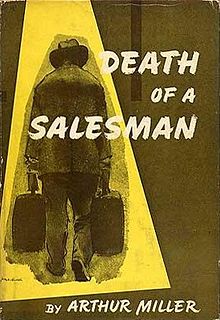
Death of a Salesman by Arthur Miller is a powerful story that revolves around the idea that one's life can be shaped by the power of one's beliefs. Since this idea is a particularly American concept -- that if we just believe something strongly enough it will come true, no matter the external circumstances -- the play resonates with audiences that see something of themselves in the characters. The promise of the play, then, is that we experience the death of one man's dream while we continue to believe in our own dreams, deluded or otherwise.
Characters in a story define themselves by what they want. I call this a dramatic truth. In Salesman, Willy Loman still holds to the belief that he's a great salesman, that he can still talk his way into getting sales, while everything in his present life belies that lie. Willy also wants to continue living in the dream that Biff, his oldest son, could be someone important, but what derailed Biff's life keeps them estranged.
Happy, the youngest son, holds to the idea that if he just keeps believing in a particular dream -- his making it in the world of business -- his dream will come true. He's a young Willy, and the question for his character is whether he'll come to understand who he really is.
Linda's role as Willy's wife is to enable Willy's dreams about his job and about his relationship with Biff being repaired. While the role Linda plays in Willy's life -- devoted helpmate -- isn't considered the norm now (whether it ever was or not), it's still true that dreamers like Willy need and crave someone who will pretend to believe in their dreams. It is because Biff no longer believes in Willy's dreams -- that he's a successful salesman and a good father -- that their relationship ruptured.
The overall plot question of the play is set up in the title, with the question of how the main character will die. The story question also arises from the title, and speaks to the death of the main character's ability to sustain his dream about his life, his dreams for his sons, and their own ability to create their own dreams about their lives. All the main characters in the play begin the play ripe with issues to resolve and fulfill, and the action of the story's plot drives the characters to experience deeper truths about themselves. This is another aspect of popular stories, this process of taking the audience on a journey to deeper truths unlike the more diffuse experiences of life. While most people have met someone like Willy in their lives, Willy's story is designed to be deeply felt and powerful.
The opening of the play introduces Willy returning home. His first lines raise the question of why Willy has returned home.
Willy, "It's all right, I came back."
Linda, "Why, what happened." Slight pause. "Did something happen, Willy?"
Then,
Willy, "I'm tired to the death. I couldn't make it. I just couldn't make it, Linda."
This raises the question about 'what' Willy couldn't do. The simple mechanics here are of question and answer, with the questions drawing the audience into the world of the story and these characters, and each answer revealing something about the characters.
This simple process is found in many popular stories, because it serves to draw an audience forward. Some writers struggle because their story openings simply relate information or offer statements about story characters or story events.
Linda tries to offer Willy reasons for why he 'just couldn't make it.' She's clearly trying to be supportive.
Willy explains that the beauty of the scenery distracted him.
Willy, "But it's so beautiful up there, Linda, the trees are so thick, and the sun is warm."
But he ends with this line,
Willy, "I have such thoughts, I have such strange thoughts." This set up a question about what Willy is thinking.
Willy boasts about his prowess as a salesman, and Linda encourages him to ask for a job in New York so he won't have to travel. This sets up a question about how this encounter will turn out.
It then comes out that Willy's and Linda's adult sons Biff and Happy are home. The play has begun with all the significant characters on hand at a time of momentous change.
Willy becomes angry when Linda probes about his exchange with son Biff earlier that day. Willy observes that Biff has become a 'moody man.' This sets up the question, how did this change occur? The question is set out so the audience can hear it.
Linda suggests that Biff is still 'looking' for himself.
Willy becomes angry that Biff has been working as a farm hand, and he wonders what has brought Biff home. This again sets up a question the story will answer, and again the question is set out so the audience clearly hears it.
Willy also goes from exclaiming that Biff is lazy, to that Biff is a hard worker. This acts out that Willy has drifted into a mental fog, and also a recurring structure in the story, that what Willy says in one moment is often soon contradicted.
Biff and Happy are woken by Willy's outbursts, and reminisce about their younger selves and where they are now. Happy points out that Biff has lost his earlier sense of bravado. This again frames the question of where and how Biff's life went off track.
Biff relates that he's come home because he feels that he's supposed to be doing more with his life, accomplishing more than working a series of odd jobs out West on farms and ranches.
Happy relates that Willy talks to himself, and that he's often talking to Biff. This again frames the question, what happened between Biff and Willy?
The playwright, Arthur Miller, is framing the important questions so the audience can hear them. The questions aren't diffuse, or buried in mundane detail.
Happy relates how his boss keeps building bigger homes to give his life a sense of purpose.
When it comes out that the seemingly successful, content Happy realizes something is missing in his life, that frames a question, will Happy realize and do something about his life? But as soon as the question is framed, Happy spins away, back into his dream of 'making it' in a job he's just admitted he loathes. Happy can't yet break away from this dream about what his life should be, a kind of dreaming implanted by Willy.
The scene ends with Biff suggesting he see someone from his past who offered to set Biff up in business, Bill Oliver, even though Oliver accused Biff of stealing some footballs. Returning home is pulling Biff back into the dream machine, since neither brother acknowledges why someone who called Biff a thief would want to back him in a business venture.
The scene returns to Willy, who's back in the past on a day polishing his car with his young sons. A young Biff and Happy make an entrance, and it comes out that Biff did steal a football from his school, and that Willy approves of his initiative. Willy also speaks about the day he'll take Biff on the road with him, which foreshadows the event that derails Biff's life. The question of whether Biff was a thief is answered.
Giving an immediate answer to a question is part of the process of storytelling. A story question will draw an audience through to the end of a story (a story question arising from the issue of human need at the heart of a story, here about why Willy wants to die). A plot question, here, will Willy kill himself, also operates to draw an audience forward. The importance of a story question is that it gives an audience a reason to care about what happens. While that is typically done through a main character, it can also be done through characters who embody ideas that a play explores.
As the play continues, Bernard, a thoughtful, studious friend of Biff's, shows up and reminds Biff that he needs to study if he isn't going to be flunk a particular class. Willy begins to agree, then is sidetracked by Biff having printed on his sneakers the logo for a college he expects to attend on a sports scholarship. Willy is happy to support Biff's dream and to dismiss the Bernard as someone who is "liked, but not well liked," Willy's code for someone who doesn't know how to sell themselves.
Linda's appearance then brings in reality. After Willy boasts about all the sales he's made on a recent trip, Linda needs the reality of what he actually sold to plan how to pay the bills, and it comes out that Willy made much less. And what he made will just barely cover the bills of cars and washing machines that promise a better life, but then break down, always when it seems the warranty has just expired.
The car Willy just praised is now lambasted as a piece of junk.
In terms of storytelling, the positive dream is introduced, then the reality the characters can't escape. Here, that Willy's idea of himself as a great salesman has always been an exaggeration, but not an out and out lie.
Willy then confesses to Linda that he's not liked, a powerful revelation based on his earlier pronouncements about men who are "liked, but not well liked." Willy has the power to see reality; he just prefers the illusion of his dreams.
Linda cajoles Willy back into his dream world of future success, but what follows is a scene of Willy meeting a secretary in his hotel room while he's on the road. Willy has been reduced to seducing secretaries with jokes, sex and nylon stockings to get in to see buyers. This continues to foreshadow what happened when Biff sought out Willy on the road when he fails the test mentioned by Bernard.
The staging of these scenes that mix the past and present are handled with great skill. They emphasize how Willy is drifting from his present to his past to memories/scenes inspired by what happened in the past. We are being shown what Willy is muttering about. We get answers to these questions, but the questions are raised first. Some writers struggle because they offer the answers ahead of setting up the questions. The answers simply function as statements about characters, instead of questions that arise from a story's promise that draw an audience forward to get answers.
In the past, Bernard warns Willy that Biff is at risk of flunking a state test, that he's in trouble for stealing, and Linda chimes in that all the local mothers fear Biff for how he comes on to their daughters. The dream machine is collapsing until...
Happy arrives on the scene and brings Willy back to the present, but Willy immediately reminisces about Uncle Ben, who wanted Willy to accompany him on an adventure to Africa to look for diamonds. Uncle Ben becomes another type of dream, the 'What if...' This reminiscence about Uncle Ben foreshadows his actual appearance in the play.
Charley now makes an appearance; he's a neighbor of Willy's. Charley offers to play cards with Willy, and then suggests to Willy that he could offer him a job as well, but Willy is dismissive of Charlie, insulting. Then Ben appears, and with his appearance Willy relates to Charley that a letter from Africa recently announced Ben's death. While Willy plays cards with Charley, he speaks to Ben, and relieves the idea that if he'd just gone off with Ben as a young man, he would have been more successful.
Willy accuses Charley of cheating, and Charley leaves.
Willy drifts back into the past, when Ben paid him a visit in New York. Willy wants to know more about his father, who was also an itinerant salesman.
Charley returns, also as a young man, and warns Willy that Biff and Happy have been stealing from a local construction site. Willy starts to chastise Biff and Happy, then praises their fearlessness to Ben, while Charley points out that prison is full of fearless characters.
Willy reveals to Ben that he feels 'kinda temporary about myself.' This is a powerful revelation, because it is what Biff feels about himself in the present, and reveals that Willy has always struggled to maintain a dream about the purpose of his life.
As Ben leaves, what Willy takes from their encounter is that he's been right to encourage his sons to be fearless.
Linda comes out in the present to talk to Willy, and he wanders off on a walk in his slippers. When Biff and Happy join Linda, the conversation soon turns to an ultimatum from Linda to Biff: that he either respect his father or leave and not come back.
This ultimatum drives the action, and sets up what Linda says about Willy and his worth as a human being: "He's not the finest character that ever lived. But he's a human being, and a terrible thing is happening to him. So attention must be paid."
With these lines the playwright is speaking not just about Willy, but about every other working stiff in the world who has struggled to make ends meet. Miller has something to say to the world through this play about the innate dignity of people.
As the scene continues with great intensity, Biff refuses to tell Linda why he and Willy are estranged, but he does offers to stay and get a job in New York. Linda counters that Willy has been getting by on $50 a week from Charley that he presents to Linda as money made on sales calls Further, that he has been trying to kill himself.
Willy's return spirals into another argument with Biff until Happy comes up with the idea that he and Biff can start a business that revolves around sports exhibitions. Willy loves the idea, and begins to spout contradictory advice and shush Linda who tries to be encouraging, while Biff is enraged by Willy's tone with Linda. The tension in the scene builds until Willy leaves, but the question of whether Biff will go up to see Willy one more time for a re-approachment comes up.
Biff does manage to say goodnight to Willy without igniting another argument. The end of Act One comes with Linda meekly asking Willy what caused his estrangement with Biff but getting no answer (this sets this up to be a question answered in the next act). The act ends with Biff removing the tube from the water heater, part of Willy's plan to commit suicide. This frames the potential suicide as a question, as it's clear that, in spite of the happy dreaming, Biff's meeting with Bill Oliver will be a failure.
The full review of Death of a Salesman can now be downloaded from Smashwords for .99 as a PDF, Kindle, or html. The review is part of a collection that includes reviews of Romeo and Juliet, Hamlet, The Iceman Cometh, and the Heidi Chronicles.
Top of page Information about Bill's plays. I've created a site on YouTube called Oregon Writers Speak. It includes two clips by Elizabeth Lyon speaking about writing query letters and writing with voice and myself speaking about deep characterization, and playwright John Donnelly speaking about the craft of writing for the stage.
